
Feature by John “Spoons” Sponauer
Introduction
It’s hard to come up with an aircraft further from the style of combat preferred by the US in the 1990s than the A-10 Thunderbolt II. It isn’t supersonic, rarely carries “smart” bombs, has very few computerized systems, and most definitely isn’t in its peak flight envelope for the high altitude, low exposure, high precision strikes carried out throughout the decade. It rarely creates good video of bombs slamming home for the evening news, and has very little ability to tangle on any sustained level with enemy aircraft. The truth is, it would probably be outperformed by several fighters from the WWII generation.
That so many A-10s are still in use today and have seen so much action in the past ten years since Desert Storm is due to the factors that make the aircraft an enduring national asset…..its innovative pilot community and its ability to fly a long time, sustain battle damage, and give back firepower in spades.
Much has been written about the A-10’s performance in Operation Desert Storm, but it bears repeating. Operating in an environment that was polar opposite to those in which it was designed for, using tactics created “off the shelf” by its crews, and outclassed in performance by essentially every other aircraft in-theater, the A-10 was very much a low-tech star of the high-tech war in the desert. The numbers alone are staggering, especially for an aircraft due to be phased out of the USAF inventory…these figures come from Part Two of The History of the A-10 Thunderbolt II, written earlier this year by SimHQ’s own Willem Aalbers:
- Missions flown:8775
- Recorded Kills:
987 Armored Vehicles
1106 trucks
926 Artillery pieces
501 APCs
249 CPs
51 Scud launchers
11 Frog Missile Launchers
112 Military Structures
96 Radar installations
72 Bunkers
10 Enemy aircraft (on ground)
2 Helicopters
9 SAM Sites
8 Fuel Tanks
Warthogs over Iraq 1991-2001
The A-10’s performance during Desert Storm, as well as the wide variety of missions that it was able to accomplish, impressed the USAF, which curbed plans to retire the aircraft and rely on faster, modified F-16s for much of the A-10’s tasks. Some of the new missions that the A-10 performed in the Gulf War with merit, such as the innovative night-fighting capability and the ability to serve as functional airborne forward air controller aircraft, were increasingly made the focus of the A-10 community, as there was no other plane in the inventory or planned that could do so many tasks so well. The A-10’s heavily armed and armored airframe proved time and time again in Desert Storm that it could both take and deal punishment in combat, and both of those traits could also serve well in the roles identified by the USAF for the aircraft. It wasn’t long before the Hogs would be in action, and in these conflicts the aircraft and its crews proved critics wrong once again.
Northern Iraq: Food and Fighting
Operation Provide Comfort (April 6, 1991 – July 24, 1991)
With Iraq’s military in shambles, minority groups in the northern and southern parts of the country were encouraged by the US to revolt and rise up against the Hussein government. In northern Iraq, Kurds, a long-repressed ethnic group in the nation, struck at government forces and captured towns in their region throughout March of 1991. Whatever success the Kurdish forces experienced, however, was soon wiped out by a strong Iraqi counterattack, using ground forces and helicopter gunships to attack the rebels. The Bush Administration, wary of being drawn into a civil war, did not provide military support for the Kurds, and within days, the rebellion was crushed and any lost territory was reclaimed.
Fearing Iraqi retribution, more than 1 million, and possibly as many as 3 million, ethnic Kurds headed for the rugged, mountainous Turkish border and set up camp. Disease, cold weather, and the rough conditions, not the mention the Iraqi Army in pursuit, killed hundreds of refugees, particularly the very young and very old, each day.
In early April, the United Nations passed resolutions against Iraq’s actions and requested that member nations take steps to assist and protect the Kurds. President Bush authorized the US military to participate in aid operations, as well as to provide protection for the Kurds.
Incirlik Air Base in Turkey, used heavily in the Gulf War, rapidly became the hub of activity for Operation Provide Comfort. On April 7, the first airdrops of food and supplies to the Kurds began, an effort that would eventually involve more than 30 countries as part of the coalition. The major forces involved were from the US, UK, France, and Turkey, the latter increasingly worried about Kurdish influence on its own population.
By mid-April, the UN established formal refugee camps in Northern Iraq, with US Special Forces and US Marines taking the lead in oversight and operation of the facilities.
Unsure what Iraqi response would be to the sudden infusion of Western aircraft and troops within its borders, the US established a large military force to assist in the operation’s security, and A-10s played a major part in that. While F-15 and F-16 fighter aircraft established a “no fly zone” above the 36th parallel, an E-3 AWACS plane coordinated air operations for the region and tanker aircraft provided refueling support. Heavily loaded transport aircraft on their way to make parachute drops of supplies to the Kurds were increasingly vulnerable to ground fire, and with the fluid masses of refugees and scattered Iraqi forces nearby, it was established that escort aircraft would be needed to protect the airdrops. With its slow speed, great visibility, and established reputation, the Warthog perfectly fit the bill.
A-10s from the 92 TFS deployed from Bentwaters, UK to Incirlik on April 6, and the first Hog missions were flown on the 7th and 8th. The initial role of the A-10s was actually to fly through the numerous valleys of Northern Iraq, help find the refugee camps, identify them for the transports, and then provide cover for the cargo planes as they dropped supplies.

For several weeks, until a temporary airstrips could be created and transport aircraft landed, the cross-shaped A-10s were the first sign to Kurdish refugees and watching Iraqi forces that an airdrop was coming. Flying low and ahead of the transports, A-10 pilots scanned for ground and helicopter threats to both the cargo aircraft and the refugees below.
Throughout May, this task was lessened as fewer and fewer airdrops were needed, but the A-10s out of Turkey still flew orbits over the area, on the watch of Iraqi ground movement. In mid-May, the tense nature of the situation was revealed when an A-10 and an F-16 were taken under fire by Iraqi anti-aircraft guns in two separate incidents. In general, though, threats were light, although Iraqi units were out in force.
Operation Provide Comfort officially ended on July 24, 1991 after 40,000 sorties delivered more than 17,000 tons of supplies to the Kurds. About 80 percent of the villages destroyed by the Iraqi counteroffensive were restored, and increasingly many of the refugees returned to their homes. At the same time, Operation Provide Comfort II began, with less of a focus on humanitarian relief and more of an emphasis on banning Iraqi action north of the 36th Parallel. Within weeks, the ground elements of Provide Comfort pulled out of Iraq, leaving only small units behind and focusing almost entirely on air units to “keep the peace.”
Operation Provide Comfort II (July 24, 1991 – December 31, 1996)
For the five years that the operation existed, the US Air Force flew about 60 percent of the sorties for Provide Comfort II, and more than 4,500 sorties in 1996 alone. Some supply missions continued throughout Northern Iraq, but the operation was largely military in nature, with the purpose to contain Hussein in the region.
Threats to the aircraft were very real, and exchanges of fire isolated but frequent. In early 1993, events heated up greatly, with air to air kills against Iraqi fighters and ground strikes against air defense systems. What role the available A-10s played in the surge of fighting isn’t clear, but it seems likely that action was limited to combat search and rescue operations, as the US relied heavily on high-altitude retaliatory strikes using precision-guided weapons during this time.
In 1995, the UN assumed control of the small remaining humanitarian portion of Operation Provide Comfort II, leaving just a combat role for the patrolling planes above, as part of Operation Northern Watch.
Operation Northern Watch (January 1, 1997 – Present)
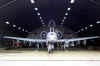
The sorties of Provide Comfort I and II turned into Operation Northern Watch. For years, and even to the present day, aircraft from Incirlik Air Base have conducted near daily sorties over Northern Iraq, and shooting incidents have become extremely common.
Most of the combat sorties have not involved the A-10, but instead F-16CJ Wild Weasels, F-15E Strike Eagles, or RAF attack aircraft. From about 1994 on, there was no A-10 presence in the region until about a year ago, when A-10s were again stationed at Incirlik, this time for CSAR duty.
Speaking in an interview in January 2001, an A-10 pilot assigned to the 303rd EFS, call sign “Rags” (names of Northern Watch aircrew are not published), spoke of the airplane’s suitability for the task of CSAR:
“What makes the A-10 an outstanding aircraft is its ability to survive and return home even after taking several hits from heavy armor emplacements,” he said.
Although A-10s aren’t the only aircraft capable of performing the role of “Sandy,” or CSAR mission commander, they are by far the most frequent and the most effective. As the mission commander, a Sandy pilot coordinates all of the other aircraft in the region, from escorting fighters to the actual rescue helicopters. In addition, he has control of his own flight and its weapons and can support the rescue with ground fire as needed. It’s a task not too dissimilar to the forward air controller role tasked to the A-10 fleet, but with the added stress of coordinating a rescue operation that can include dozens of aircraft.
“When a pilot goes down it’s busy and chaotic up there,” said Rags. “The sandy mission commander must know the capabilities of all the other aircraft in the AOR; he must know everything from how much fuel they hold to what kind of armament they take. It’s a difficult task, but it’s a task that sandy mission commanders train for over and over again.”
That quote, in fact, sums up the entire history of post-war operations over Northern Iraq; difficult work, and something performed countless times since 1991. As of this writing, there’s no sign that the patrols over Northern Watch are subsiding, but the A-10s have been replaced in the CSAR role by the unlikely choice of the F-16, specifically the 510th Fighter Wing. The reason? According to Maj. Curt Miller of the 31st Fighter Wing, “There just aren’t enough A-10s,” which says something about both the operational tempo sustained by the USAF in the past decade and the constraints placed on a smaller and smaller A-10 fleet. How does a “fast mover” like the F-16 perform a task handled by the much slower A-10? The article states:

The A-10 goes in low and slow, “and we may not do that,” Miller said of the Fighting Falcons. “Our biggest strength is laser-guided bombs. No question. We go about it in different ways, but we are extremely effective in carrying out that role.”
Southern Iraq: PSYOPS, Bombs, and CSAR

To the south, A-10s have also taken place in patrolling the southern no-fly zone, set up after a situation similar to the Kurdish uprising occurred with local Shiites in the days following the Gulf War. In addition, the southern no-fly zone provides an early warning of sorts for any future Iraqi attack on Kuwait or Saudi Arabia. The bulk of operations are patrols flown as part of Operation Southern Watch.
Operation Southern Watch (August 27, 1992 – Present)
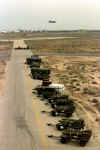
Operations over southern Iraq have taken on a similar profile as those over the north. Operation Southern Watch involves a wider range of units, however, including naval aviation forces stationed on aircraft carriers in the Persian Gulf.
However, just like their peers in the north, the missions are dangerous, repetitive, and without a visible end. The A-10 has played a role disproportionate to the small numbers of Warthogs stationed in the region, and have even widened the scope of missions performed by the aircraft and its aircrew.
In the years immediately following the Gulf War, the A-10 has been a constant presence in the region. Starting in 1994, a permanent deployment of Hogs has flown out of Ahmed al-Jaber Air Base in Kuwait, typically in strength of around a dozen aircraft. The responsibility for this deployment, as with the deployment to Turkey previously mentioned, has been rotated among the remaining Active Duty, Air Guard, and Air Force Reserve units flying the A-10. In recent years, Reserve and ANG crews from Missouri, Connecticut, Maryland, North Carolina, Louisiana, and Pennsylvania, among others, have rotated through Ahmed al-Jaber. Active Duty A-10 units from around the world (with the exception of those in Osan, Korea) have carried the majority of the deployments in Kuwait, however.
One of the primary roles for the A-10 aircrew in the region is CSAR, just as it is for those in the north. Warthogs remain on alert status at the air base to rapidly respond should one of the aircraft patrolling the southern no-fly zone be downed. A-10 pilot Capt. Ron Stuewe said in an interview in 1998 that the CSAR roles was “the best mission in the Air Force,” adding “Rescuing someone from an unfortunate incident where the priority is getting that guy back so he can look forward to another day, is a sense of accomplishment.”
Stuewe’s choice of an A-10 assignment, in fact, was partly because of the wide variety of mission.
“I chose the A-10 because of the missions we fly, and the A-10 community — from the pilots to those turning wrenches on the flight line,” he said. “There will never be a movie about an A-10, and a lot of people don’t even know what an A-10 is, but an Army guy on the ground knows what a Hog is.”
The Hog has been used for much more than CSAR out of Kuwait, however. In addition to flying patrols inside the no-fly zone, A-10s have guided in retaliatory strikes and launched attacks of their own.
The southern region has also flared up on occasion, with periods of fairly intense combat. The most notable of these was a short air campaign in late 1998 called Operation Desert Fox.
Operation Desert Fox (December 16-20, 1998)
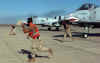
The actions leading up to Desert Fox had been brewing for several months prior. Following a period in which Iraq was not cooperating with UN Weapons Inspector teams, a limited four-night air campaign was launched. An earlier strike, planned for November, was cancelled while aircraft were in mid-air when Iraq appeared to make concessions regarding surprise inspections by the UN teams, who were looking for information about Iraq’s program for building Weapons of Mass Destruction.
The goals of Desert Fox were to strike at facilities that aided Iraq’s ability to produce, store, maintain, and deliver those weapons, and the attacks included strikes on about 100 targets. These included integrated air defenses, command and control facilities, weapons development facilities, Republican Guard barracks, airfields, and an oil refinery.
In addition to US and USMC aircraft flying from the Persian Gulf, USAF B-52 and B-1 bombers, and Royal Air Force and USAF planes from nearby bases, Tomahawk cruise missiles were used as well. Given the nature of the strikes and the type of targets, A-10s did not seem to play a significant role in most of the Desert Fox strikes. They did, however, carry out local strikes from their base in Kuwait and stayed on alert for any Iraqi armored attack on the Kingdom.
One of the roles of the A-10 community during Desert Fox, though, took on a new flavor. A-10s were used to drop psychological warfare pamphlets over Iraqi troop concentrations near Kuwait, urging the soldiers not to threaten Kuwait.
The success of Desert Fox’s 650 sorties is widely disputed but is generally regarded to have had little impact. Iraq did not put up a significant fight, it appears, and tensions continue to this day, as very likely does their weapons program. UN inspectors have not returned to Iraq since the action.
Iraq has continued its game of cat and mouse with Allied aircraft since, and in fact, even shortly after Desert Fox ended. A-10s were involved in an incident on May 17, 1999 and assisted with attacks on air defense targets near the towns of Abu Sukhayar, about 100 miles south of Baghdad, and An Nasiriyah, about 200 miles southeast of Baghdad. The strikes were prompted by an Iraqi AAA attack on patrolling aircraft, one of more than 180 such attacks since the end of Desert Fox at that time.
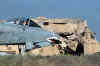
To this day, Allied pilots flying over the southern no-fly zone come under AAA and SAM fire, and the A-10s based in Kuwait continue to stand ready to perform CSAR as needed. In fact, as of the publication date of this article, there have been more than 275 incidents of Iraqi antiaircraft fire in the no fly zones…in the year 2001 alone.
The decade that roared in with an unprecedented air-land-sea battle against Iraq ended with the apparently never-ending mission of patrols along its northern and southern regions. A-10s were used throughout, and have proved their value against threats in the region in all situations.
Hogs Over The Balkans
The Persian Gulf was hardly the only region where the end of the Cold War brought with it hot tensions. In Yugoslavia, old and new ethnic and nationalistic differences flared and civil war waged as state by state, the nation came apart at the seams. Although there were earlier conflicts in Slovenia and Croatia, the world’s attention focused on Bosnia-Herzegovina, a heavily Muslim region in active conflict with Serbian forces within its borders, supplied and supported by the government of Slobodan Milosevic in Serbia proper.
The Balkans, Part One: Bosnia – Herzegovina
Operation Deny Flight (12 April 1993 to 20 December 1995)
From 1992 on, A-10s were again on the forefront of a conflict. Recognizing the vulnerable position of UN forces as well as the Bosnian population to Serb air and ground attack, the UN and NATO began flying patrols over the disputed territory in an attempt to ban fixed- and rotary-wing aircraft over Bosnia, as well as provide CAS support to UN troops on the ground near geographic “Safe Havens” outlined by the international community. This mission was called Operation Deny Flight.
It proved to be a large strain on a shrinking US military, leading to long overseas deployments to support it, as well as high operational tempos. In 1994 alone, the 52nd Fighter Wing’s O/A-10s out of Spangdahlem AB were deployed to Aviano Air Base in Italy for more than 190 days. Twelve of the Wing’s 18 Warthogs were part of Deny Flight, mostly flying orbits over the disputed land.
That relatively benign task grew hotter in early 1994, when several incidents occurred, including a shootdown of four Serb aircraft (February), a CAS mission near Gorazde (April) carried out by F-16s and F/A-18s, and attacks on several NATO aircraft, which were either downed or fired at by ground defenses. As the situation on the ground deteriorated and safe areas fell under increasing attack, the A-10s were finally put into combat action.
Following the seizure of some heavy weapons by Bosnian Serbs from a warehouse in Ilidza, a series of sorties were launched to locate and destroy the captured equipment. On August 5, two A-10s located and strafed one of the pieces, a WWII-era M-18 tank destroyer. Following the attack, which was believed to have been successful, the Serbs returned the remaining heavy weapons.
A-10s entered the picture a little over a month later as well, when a OA/10 and two RAF Jaguars (presumably controlled by the OA-10 FAC) attacked a Serb tank located within the identified 20 mile “exclusion zone” around Sarajevo.
Operation Deliberate Force (29 August – 15 September 1995)
As fighting progressed, world opinion increasingly pointed to the distinct possibility of Western military intervention in the conflict on the behalf of the Bosnian Muslims.
Not-so-veiled threats were made that attacks by Serbian forces on the established Safe Areas would lead to further escalation by the West. As July approached, even more warnings were made that further Serb actions against the cities of Gorazde, Tuzla, Bihac and Sarajevo would be met with force. Apparently wishing to test NATO’s resolve, Bosnian Serbs continued attacks on several safe areas, including a mortar attack on a crowded market in Sarajevo that killed or wounded dozens.
On August 30, 1995, NATO launched Operation Deliberate Force, an eleven-day air campaign aimed at about 50 Bosnian Serb positions. By the time it was over, more than 3,500 sorties had been flown and more than 1,000 bombs dropped. The US carried much of the burden of the attack, with about 65 percent of the sorties, followed by the UK, France, and The Netherlands. The nature of the conflict, and the political need to minimize NATO losses, essentially dictated the precision-guided munitions be used for the majority of the strikes…in total about three-quarters of the bombs dropped were PGMs.
In light of this, the role of the A-10 was somewhat muted during the action. Although it’s certainly capable of carrying PGMs, the Warthog isn’t the optimum platform for these bombs. That’s not to say that the A-10 played a minor role in the conflict, however. Twelve O/A-10s flying out of Aviano provided a respectable ground attack force, and in fact only the F-16 and F/A-18 were used in larger numbers. Although it’s difficult to ascertain exactly what missions were flown by Warthogs, it’s known that more than 10,000 rounds of 30 mm. ammunition, 23 EO/IR Mavericks, more than 300 iron and cluster bombs, and 20 FFAR were expended by NATO forces. A scan through NATO’s summary of the operations hints at several missions likely performed by the Aviano Warthogs.
8 Sept 1995: Nineteen CAS aircraft were re-tasked against eight fixed targets
8 Sept 1995: A third helo-borne reconnaissance mission to locate and rescue [downed French aircrew] was executed
- Weather was good and a thorough search of the area was performed without result
- Mission came under attack from small arms fire; suppressing fire was provided by escorting gunship and fighter aircraft
- Two helicopter crew members were wounded and a helo damaged on egress, but all mission aircraft/aircrew recovered safely
10 Sept 1995: At 1425, UN requested CAS support following BSA (Bosnian Serb Army) shelling of UN positions near the Tuzla airport; three flights of fighters supported the CAS request; two command bunkers and an artillery position were identified, targeted and successfully engaged
Several factors played into combat operations over Bosnia. Poor weather at times severely restricted visibility for the attacking aircraft, and low clouds and deep valleys below made low-level attacks perilous and put crews at much higher risk to ground fire. A typical day in Bosnia presented low valley fog in the mornings, followed by afternoon clearing, and then increased storminess later in the day.
In addition, the role of finding ground targets as a FAC, while at altitude, presented unique challenges. One Pentagon media briefer during the operation, a former FAC himself, put it this way:
Let’s just take an example of trying to deliver a precision munition such as a laser-guided bomb or a Maverick which the weapons delivery parameters are somewhat similar for, and the aircrew would have the aircraft up about 15,000 feet and be in a slight descent, maybe no more than 10 to 15 degrees. But I’ll try to put the distances into perspective for you of what goes on in terms of the aircrew looking out trying to deliver a weapon on a target, and I’ll try to put it in perspective of some distances that you all can relate to here in the Washington area to give you a feel.
Let’s say we had a tank at the base of the Capitol building. In order to deliver a precision munition against that tank, the aircrew would have to acquire the target from a distance away of about where Arlington Cemetery is. So that’s about the distance, a 15,000 feet slant range. That kind of slant range — distance from Arlington to the Capitol — is about where they would have to see the target the size of a tank.
Granted, the equipment on board the aircraft — you’re not doing all this with a naked eye, although you had a general idea of target area from target study that you’re looking out. You see the Capitol or you see the general area that you know from target study you’re supposed to be in, but you have equipment on board that allows you to see up much closer onto the target through electrical optical systems that help you make sure you’ve got the right target. Nevertheless, about from Arlington Cemetery to the Capitol is where you’ve got to see it.
You need to start lasing the target for a laser-guided weapon about the time you come over the Lincoln Memorial, and release it about that point as you pass over the Lincoln Memorial. Then you need to start your recovery maneuver so that you don’t go any closer than where the Washington Monument is to the Capitol. Those are some pretty good-sized distances we’re talking about.
Doing this, you’re doing it all at an airspeed of about 500 knots — which to put that in perspective, at that airspeed you can travel from the Beltway to the Pentagon in a minute. There are those who wish to get here in the early morning hours that way. It would be nice to be able to do it in a minute, but that gives you a feel for the speed.
Another relationship of the speed would be if you’re traveling along on the Beltway out there at 60 miles an hour, it’s ten times as fast as you see things going by. So it’s a substantially increased speed from what you’d see in a car, as you would expect; but you know how fast things pass you by when you’re looking up close, and even off at a distance. It’s ten times that fast.
So things are happening quickly, and this is if everything’s perfect. You throw onto this that a person who’s delivering the weapon can’t be looking out at the target all the time. They’ve got to take into consideration what’s going on around them. There are other aircraft they’re having to watch out for, and, more importantly, having to look out for SAMs and AAA, because we get target fixation, as we call it. That’s how people get shot down. They’re not paying attention to what’s happening, they’re having to pay attention to the weapons delivery, but there’s a lot of other things they’re having to look at.
Smoke, weather, as you can see here, and just general atmospheric conditions can also cause problems.
NATO and the US considered Deliberate Force a victory, as the siege of Sarajevo was lifted as a result of the strikes, and eventually, the warring parties met in Dayton, Ohio to reconstruct a post-war arrangement for the region.
Operation Decisive Edge, Deliberate Guard, Joint Guard, and Joint Forge (1996 – Present)
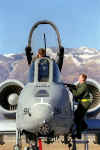
The end of the conflict and the subsequent signing of the Dayton Peace Accords may have formally ended the fighting, but animosities remained and exist to this day. Through a succession of “Deny Flight”-type of operations, NATO, led by the US, have continued patrols over Bosnia in order to prevent further outbreaks of open violence. A-10s have played a major role in that, especially active duty units like the 81st FS.
Even about six months after the end of open hostilities, the threat to NATO aircraft, especially low-flying A-10s, was a very real one. In an interview in May 1996, Lt. Col. John H. Bordelon, commander of the 47th Fighter Squadron operating out of Aviano, stated that a major threat was shoulder-fired weapons controlled by irregular forces on the ground, who typically wouldn’t consider themselves a party to the peace talks. Bordelon said that they were fairly confident that both sides were no longer using radar-guided SAM systems, as stipulated by the treaty. He expressed frustration, however, at being on the watch for the smaller, man-portable systems, possibly being operated by small groups of soldiers.
“We don’t know where they are. So, there’s always the risk of some renegade taking a shot at you,” he said.
Bordelon’s unit was also on the cutting edge of A-10 technology, though, as the unit began to operate all hours of the day using helmet-mounted night vision goggles. The new gear was introduced in 1994 and the unit used the goggles operationally in April 1996 while on rotation to Aviano. While many USAF aircraft are equipped with pods such as LANTIRN, the A-10 community had long been forced to improvise, using flares and their IIR Mavericks during the Gulf War to find and kill targets at night. The NVGs permitted aircrews to fly unassisted and without the drawbacks of flares, such as their limited burn time and the fact that they often light up both target and the attacker.
In an interview, Col. Jim Mills, Operations Group commander for the 917th, said the goggles are “a critical addition to our repertoire.”
“If the Army wants to fight 24-hours a day, we’ve got to be able to support them 24-hours a day. NVGs now give us the capability. They don’t turn night into day, but it’s close enough,” said Mills.
The dangerous terrain below at first necessitated that all night flights be conducts at altitudes in excess of 2,000 feet for safety, but as pilots became more comfortable wearing the NVGs, altitude restrictions were lowered. The cockpit on the A-10s needed to be adjusted so that their lights didn’t wash out the goggles as the pilot scanned the instruments, however, teething problems aside, the pilots quickly found that the goggle permitted great improvements.
“Using the current generation of NVGs is like day flying — but everything looks green,” said A-10 pilot Capt. Bruce Miller. “Now, we can go anywhere to look for targets, attack them ourselves, or mark them with flares so someone else can drop bombs on them,” Miller said. “The goggles let us to do all the things we can do in the daytime — we can see the ground, the other airplanes — and they allow us to do aggressive maneuvering.
“You can see the other guy shooting at you — the muzzle flashes, sometimes the bullets coming at you. The situational awareness is so much higher,” Miller said. “If you see a guy smoking cigarette, he’s toast. You know exactly where he is.”
Using their experience with the gear, the unit then went on to train other USAF units in the operation of the goggles. To reach the skill level of using the goggle tactically, the pilots are required to fly two FAC-guided missions 25 hours of night flight time.
Once again, the A-10 community expanded its bag of tricks, pushing the aircraft and aircrew far beyond what the designers and supporters of the A-10 could have dreamed when it was created.
Related posts:
 Desert Litening: The 103rd FW in Iraqi Freedom
 Page 2
Desert Litening: The 103rd FW in Iraqi Freedom Page 3
Desert Litening: The 103rd FW in Iraqi Freedom
Desert Litening: The 103rd FW in Iraqi Freedom Page 2
Desert Litening: The 103rd FW in Iraqi Freedom Page 3
 Hogs In a “Hot” Peace: The A-10 Since Desert Storm, Part Two
 Q&A with Oleg Maddox on “Storm of War: Battle of Britain” Page 2
Q&A with Oleg Maddox on “Storm of War: Battle of Britain” Page 4
Q&A with Oleg Maddox on “Storm of War: Battle of Britain” Page 2
Q&A with Oleg Maddox on “Storm of War: Battle of Britain” Page 4
 Spy in the Sky Page 3
 Volume 5: Raid on the Sun Page 2


